Featured research
Scalar Perturbations around a White Hole
I investigated massless scalar perturbations on a Schwarzschild exterior after reversing the usual black-hole horizon condition: instead of allowing waves to enter the horizon, the inner boundary was required to support only outgoing radiation. Using two complementary numerical formulations, I studied how this modification affects sourced and source-free wave evolution, detector response and ringdown.
- Status
- Completed · 2025–2026
- Institution
- Center of Gravity
- Niels Bohr Institute
- University of Copenhagen
- Supervision
- Vitor Cardoso
- Project
- 15 ECTS research project
- Assessment
- Grade: 12
Research question
How does replacing the standard ingoing black-hole horizon condition with an outgoing white-hole condition change the evolution of scalar perturbations, and which observed effects remain robust across different numerical formulations?
Context and motivation
Black-hole perturbations typically display prompt response, quasinormal ringing and late-time tails under an ingoing horizon condition. Much less is known about how the time-reversed, outgoing condition behaves in practical time-domain simulations. The problem connects to wave-propagation and point-particle methods used in EMRI and self-force modelling, although this project does not model a complete inspiral.
My contribution
My work included formulating and testing sourced and source-free scalar-field evolutions, implementing complementary time-domain and characteristic approaches, validating the black-hole implementation against reference solutions, performing parameter and resolution studies, fitting numerical waveforms, and assessing which conclusions were supported by the simulations.
Four-stage scientific narrative, figures, results and limitations.
01 · Physical question
What changes when the horizon emits rather than absorbs?
A Schwarzschild black hole is normally modelled with an ingoing horizon condition: perturbations may cross the horizon but cannot propagate outward from it. The corresponding white-hole condition reverses this behaviour and permits only outgoing radiation at the inner boundary.
I studied a massless scalar field on a fixed Schwarzschild exterior. Spherical-harmonic decomposition reduces the problem to radial and temporal evolution for each (ℓ,m) mode. The system was probed both by prescribed particle sources and by localized, source-free initial data.
- Fixed Schwarzschild background
- Massless scalar perturbation
- Spherical-harmonic decomposition
- Sourced and source-free evolution
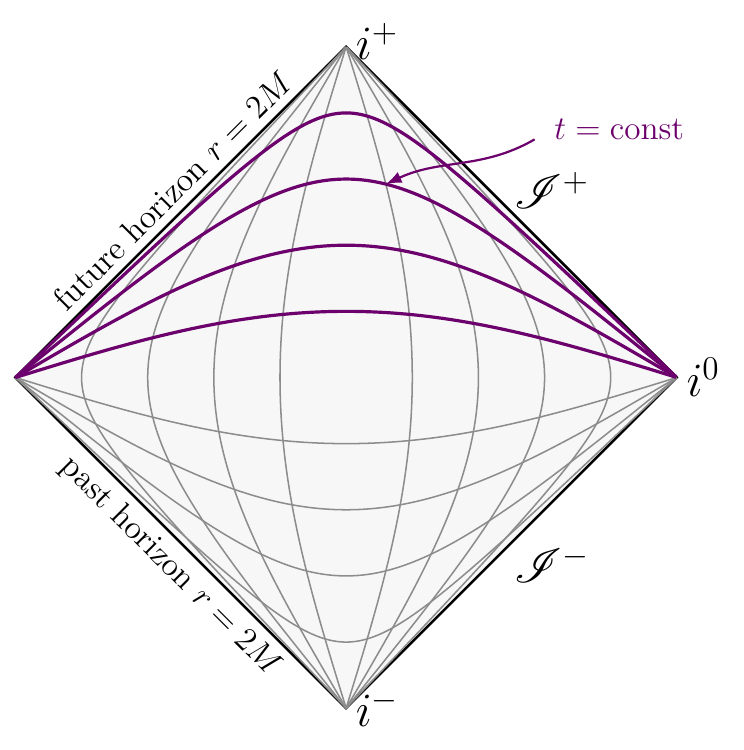
t = constant slicing
u = constant slicing
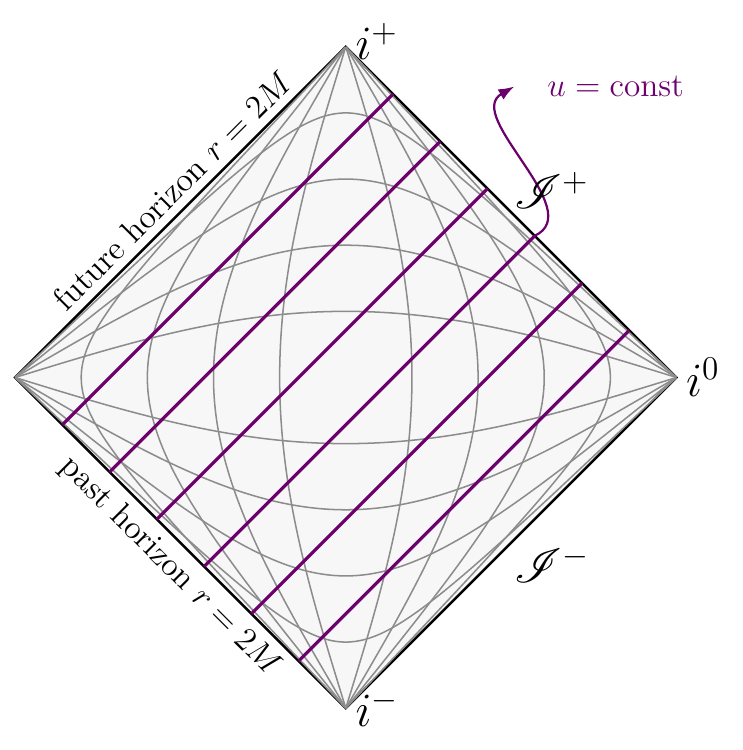
Two foliations of the Schwarzschild exterior. Constant-t slices support the primary time-domain formulation, while outgoing constant-u slices meet the horizon as a characteristic surface.
02 · Formulation
One physical condition, two numerical formulations
After spherical-harmonic decomposition, each mode satisfies an effective 1+1-dimensional wave equation containing the Schwarzschild scattering potential and, in sourced evolutions, a localized particle source.
The outgoing white-hole condition was realised in two ways. In the t-slicing formulation, it was imposed as a Sommerfeld condition at a finite inner grid boundary. In the characteristic u-slicing formulation, the horizon became part of the characteristic geometry, and outgoing behaviour was enforced through regularity rather than an independently prescribed boundary update.
Comparing the two approaches made it possible to test whether observed features were robust consequences of reversing the horizon condition or depended on its numerical implementation.
t-slicing
- Finite-radius inner boundary
- Finite differences and RK4 evolution
- Outgoing Sommerfeld condition
u-slicing
- Outgoing null slices
- Compactified radial coordinate
- Regularity at the characteristic horizon
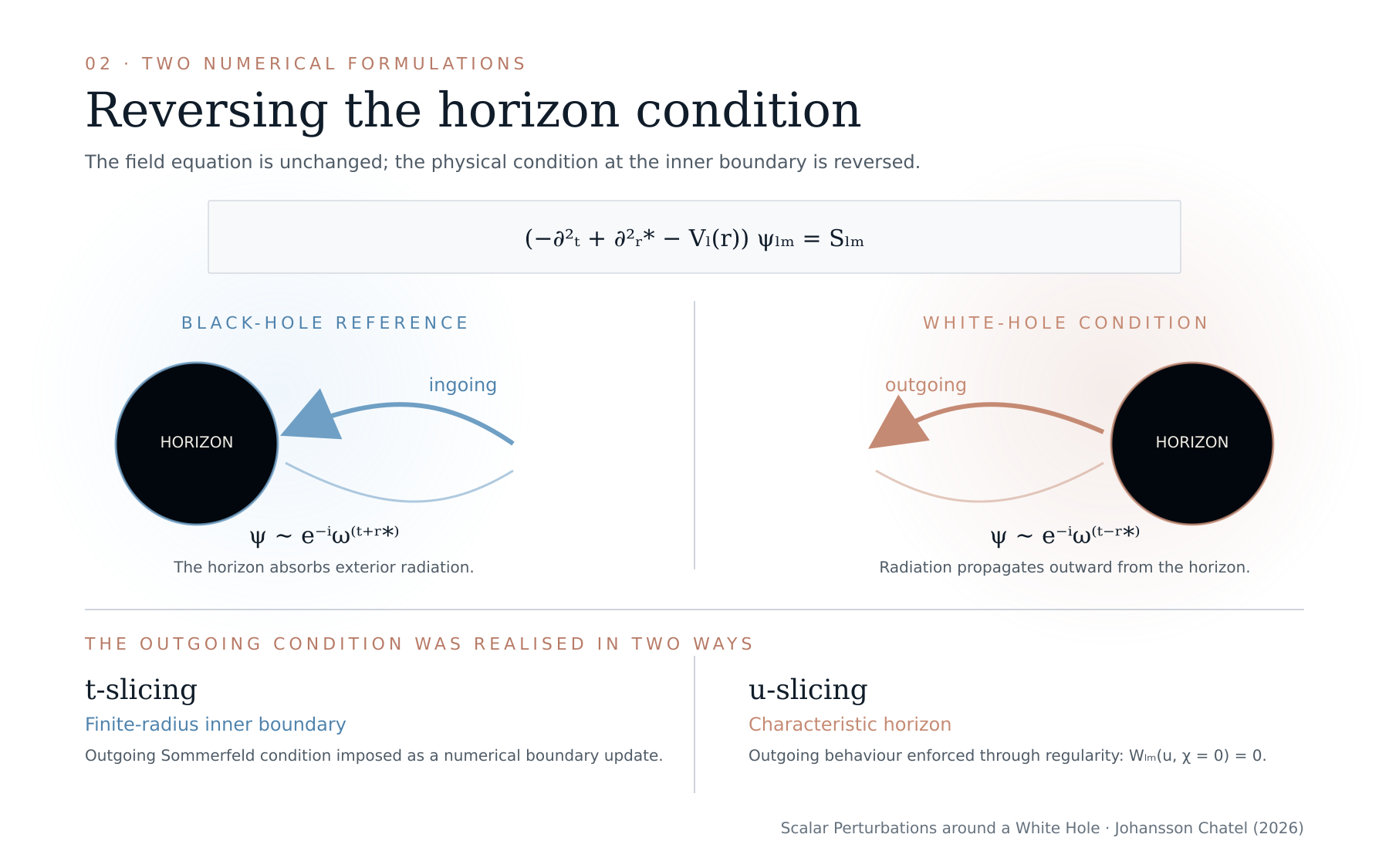
The scalar-wave equation is unchanged, but the horizon condition is reversed. The outgoing condition is then realised either at a finite inner boundary in t-slicing or through regularity at a characteristic horizon in u-slicing.
03 · Numerical experiments
Testing causality and the scattering response
The equations were evolved using finite-difference methods and fourth-order Runge–Kutta time integration. Before studying the reversed horizon, the black-hole implementation was checked against analytic and frequency-domain reference solutions.
The first experiment switched the inner condition from black-hole to white-hole form during an evolution. Because the detector was separated from the inner boundary, a genuine boundary-induced change should appear only after the corresponding light-travel time.
A second experiment evolved modulated Gaussian wave packets and compared the detector amplitude before and after their interaction with the inner boundary and exterior potential. Repeating this scan across frequencies and multipoles revealed a structured, mode-dependent response.
- Fourth-order finite differences
- RK4 time integration
- Boundary-location studies
- Frequency and multipole scans
- Analytic and frequency-domain validation
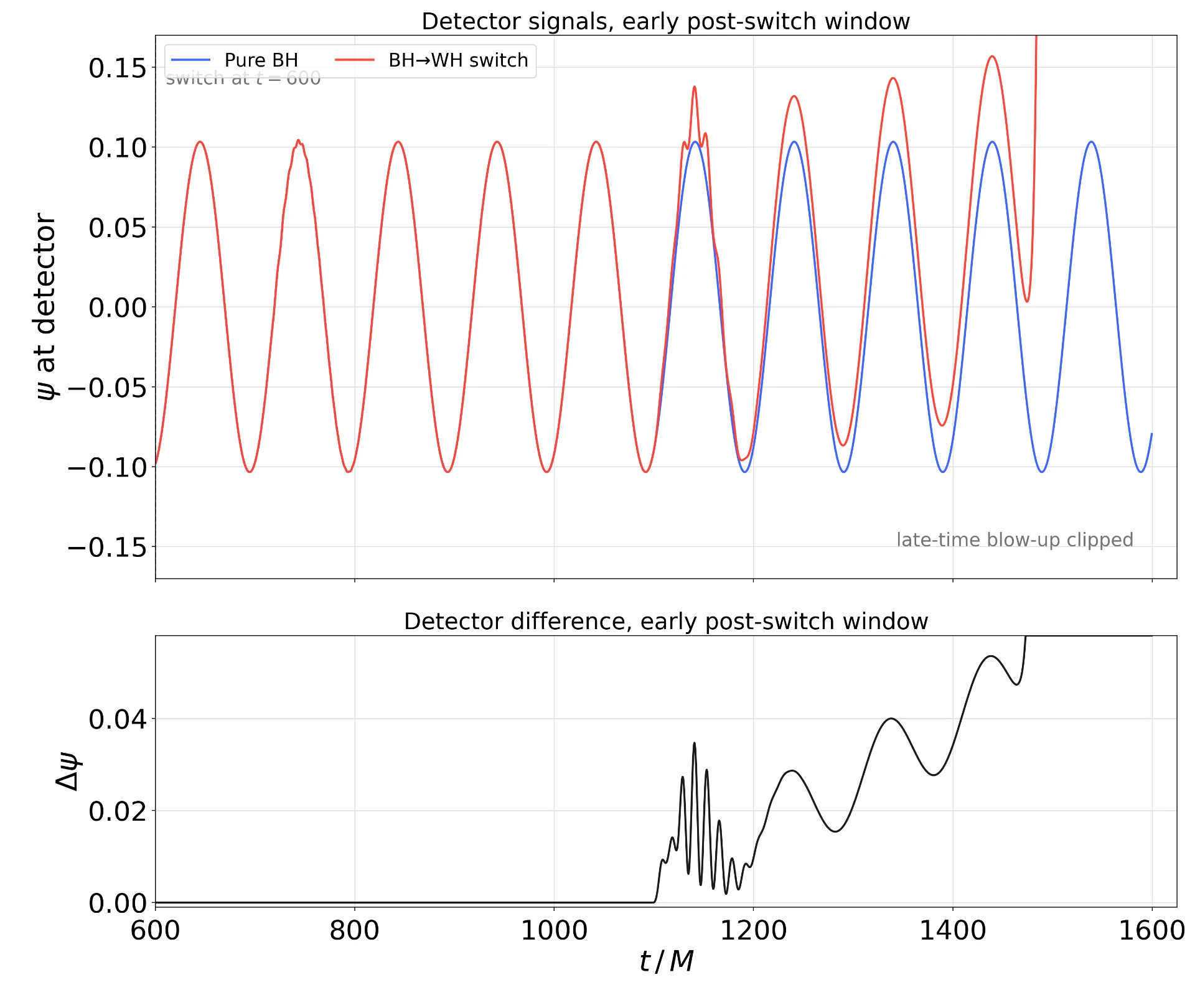
The boundary condition is changed at t = 600M, but the detector does not respond immediately. The signals separate only after the expected propagation delay, showing that the change originates at the inner boundary and travels causally outward.
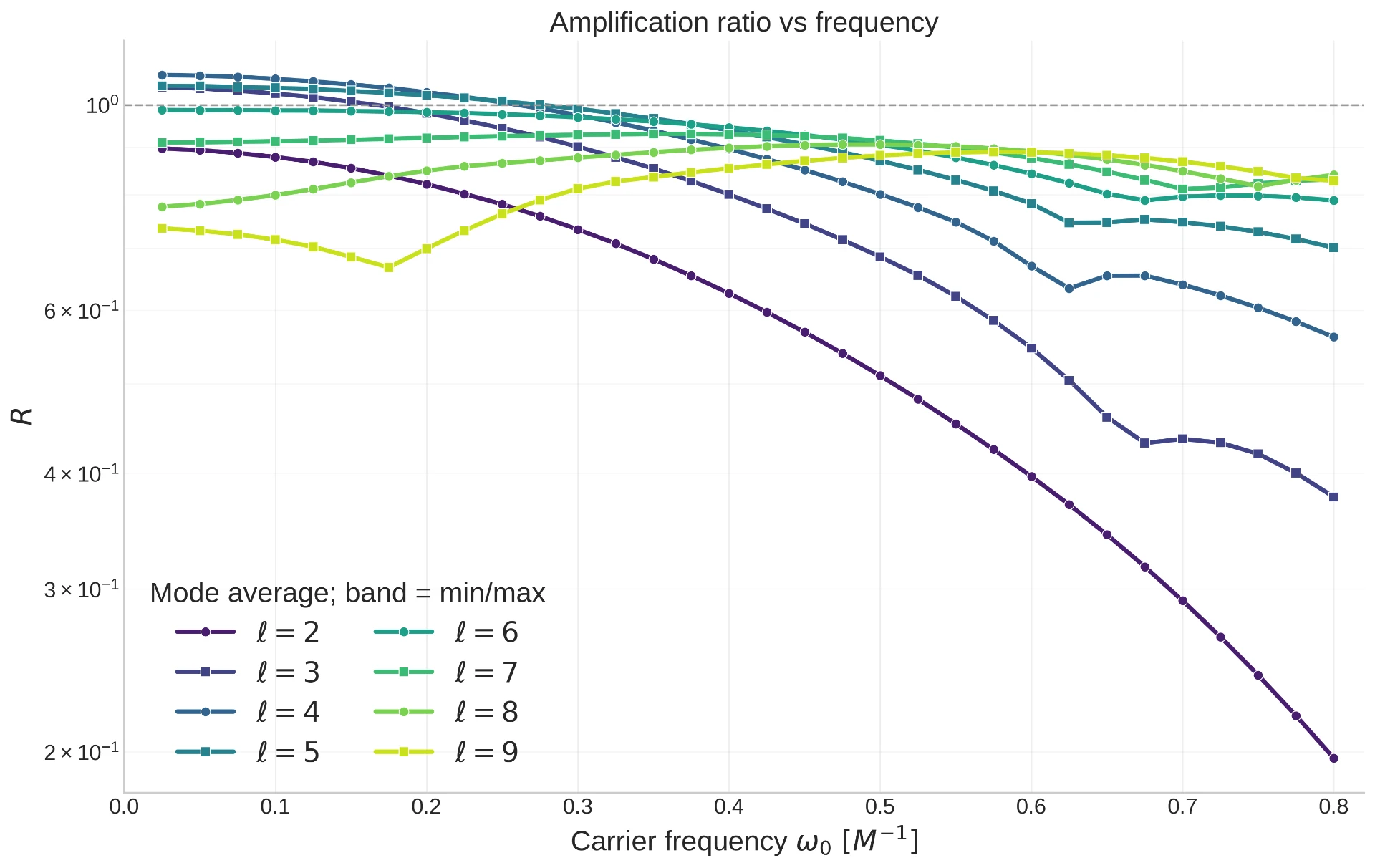
The returning detector amplitude depends systematically on carrier frequency and multipole number. The plotted quantity is a detector-level round-trip ratio, not a conserved energy-reflection coefficient.
04 · Findings and interpretation
The late-time response depends on the formulation
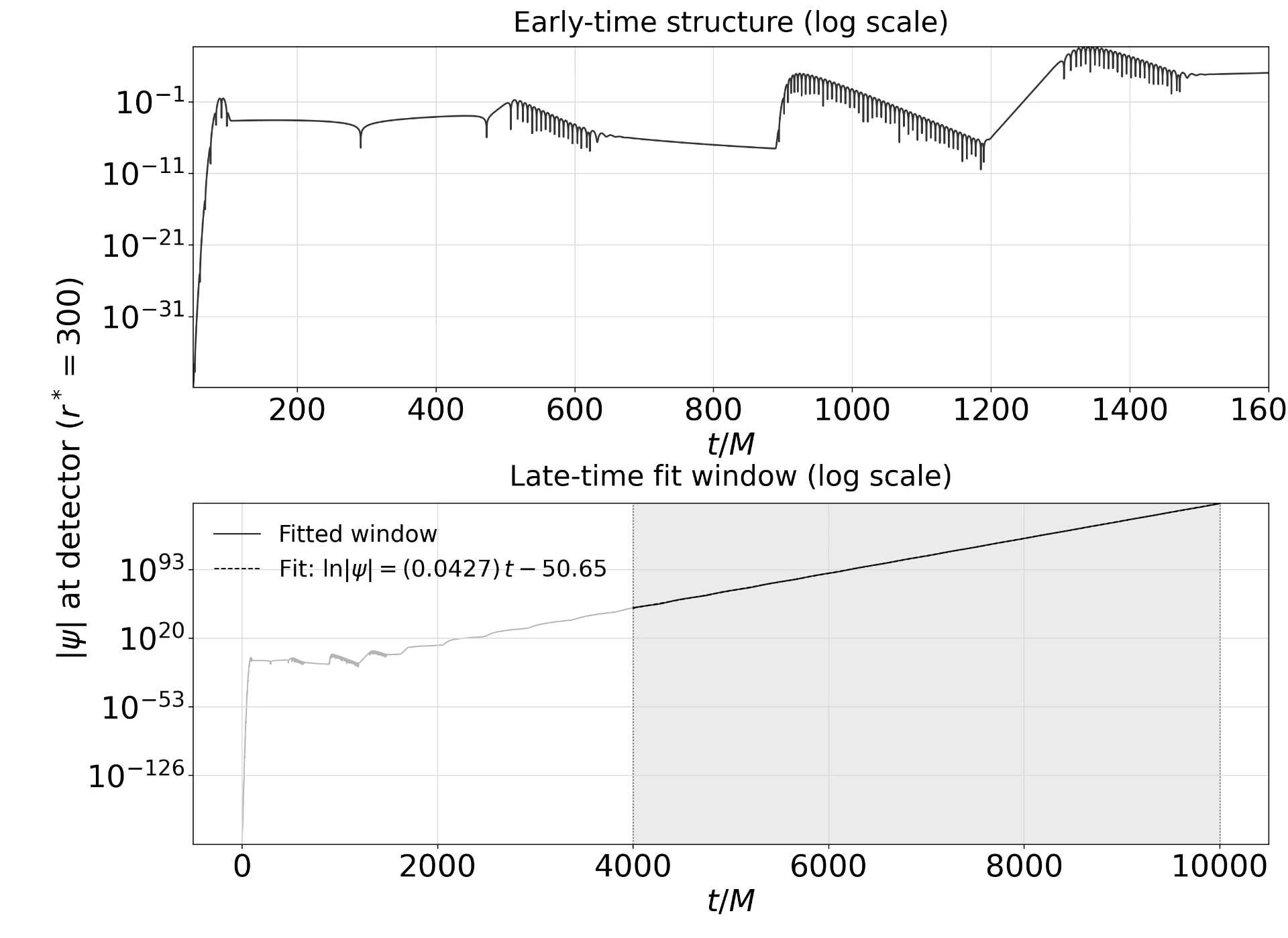
Reversing the horizon condition materially changed the exterior scalar-field response. In the t-slicing implementation, the modified boundary produced a causally delayed departure from the black-hole reference, a frequency- and multipole-dependent detector response, and strong late-time growth in both sourced and source-free evolutions.
The characteristic u-slicing formulation produced a different outcome. Its source-free ℓ = 2 evolution contained a decaying, two-component oscillatory phase, while the ℓ = 0 case did not provide a stable ringdown window.
The contrast between the two formulations is a central result: the observed late-time behaviour is highly sensitive to how the outgoing horizon condition is represented numerically.
t-slicing · finite-radius boundary
u-slicing · characteristic horizon
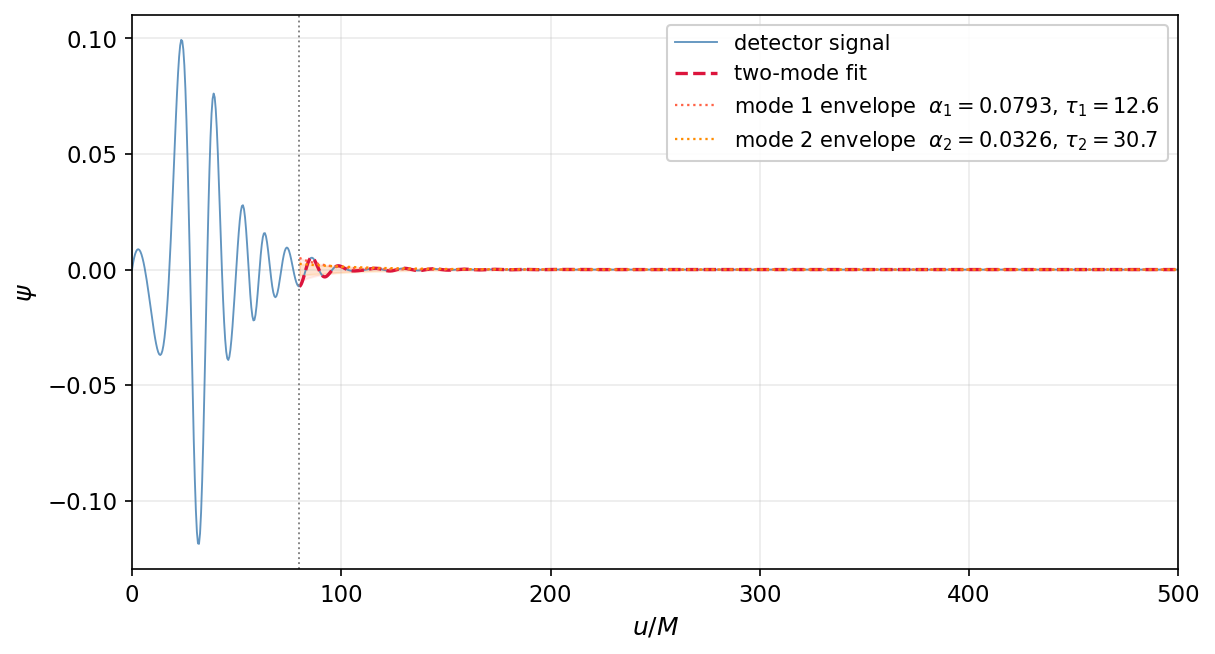
Two numerical realisations of the outgoing horizon condition produce qualitatively different late-time responses: strong growth with the finite-radius t-slicing boundary and a decaying ℓ = 2 oscillatory phase in the characteristic formulation.
What the simulations establish
- The changed inner condition influences the exterior solution causally.
- The detector response depends on frequency and multipole number.
- The finite-radius t-slicing implementation exhibits strong late-time growth.
- The characteristic ℓ = 2 evolution exhibits a decaying oscillatory phase.
Limitations
The detector-amplitude ratio is not a conserved energy flux and therefore does not establish net energy amplification. The t-slicing growth rate was not shown to converge to a unique continuum value. Because the two formulations differ in more than their boundary treatment, the project does not determine whether their contrasting late-time behaviour belongs to the continuum white-hole problem or to its numerical realisation.
What the project establishes
The study demonstrates that reversing the horizon condition has a causal and measurable effect on exterior scalar perturbations. It does not yet establish a unique, formulation-independent white-hole response. Resolving that question requires flux-based diagnostics and more directly comparable numerical implementations.
Technologies
Python · NumPy · SciPy · SymPy · Matplotlib · LaTeX · Numerical integration · Scientific computing